Gaia Gionchetti, the sense of hospitality from Sardinia to Shanghai | Olianas

People
Gaia Gionchetti, the sense of hospitality from Sardinia to Shanghai
by Jessica Cani
Born on June 6, 1980 in Cagliari, Gaia Gionchetti grew up with a life divided into two seasons: six months studying in the city and six months working in Porto Cervo. It was a childhood shaped by suitcases, changing settings, and overlapping identities—the girl studying from books in town and, in the summer, working in shops and restaurants, learning how to observe people, desires, and patterns of consumption.
For a time, she believed her future lay in fashion. She worked in boutiques such as Cristina T, Dolce & Gabbana, and other luxury brands. She was drawn to the aesthetics, the rhythm, the idea of standing at the threshold between product and client, yet the kitchen kept calling her, from behind the scenes of her family homes. Her gastronomic roots were formed in the kitchens of the women in her family: grandmothers, aunts, and great-aunts—all unmarried, small in stature, tireless, “some barely five feet tall, with size 33–34 shoes,” yet capable of holding entire generations together. Gionchetti remembers them at the San Benedetto market, carts parked outside before opening time, or at tables that became laboratories of Sardinian cuisine and beyond, with hand-rolled pasta violada, coccoi bread with lard, and black olives left to dry on the balconies of Via Sonnino. “For me, cooking is sacred, and it has always been that way.”
The other side of her family is made up of merchants and artisans. “When you’re born into a family of merchants, it’s hard to be good at anything else in life,” she says with a laugh. “Commerce is in your blood.” Yet commerce is not just about selling: it is initiative, risk, and the ability to read the person in front of you. As a child, she watched her uncle open clubs and restaurants between Via San Lucifero and Via Abba in Cagliari—places without menus posted outside, where the dish of the day was decided at the market, among oysters, plateau royal, and recipes that reached Sardinia through a constant bridge with France.
It is at this intersection of commerce and food that the role she claims today was born: a gastronomic consultant with a strong commercial foundation and a very clear idea of what hospitality truly means.

After graduating, Gionchetti continued her education with a clear focus: an AIS sommelier course between Cagliari and Milan, a program in savory pastry, and certification for food and beverage service. At the same time, she never stopped working—seasonal jobs in Porto Cervo shops, years of catering in Cagliari with a friend (she handled savory dishes, her partner desserts), private events, and children’s parties.
Then came the transition to the world of structured events. For a French packaging company, she followed food and wine trade fairs across Italy, from Bologna to Milan, all the way to Sigep in Rimini. It was here that she began moving steadily among chefs, pastry chefs, brands, and prestigious tables, training her eye in how a complete gastronomic experience is built.
When Luciano Guidi called her to work at Phi Beach alongside Giancarlo Morelli in Costa Smeralda, that mosaic of experiences was already in place. Gionchetti joined as assistant to the food and beverage director, overseeing cash management, suppliers, uniforms, and relationships with both staff and guests. She also collaborated on the organization of Phi Gourmet, a festival that brings together some of Italy’s most important Michelin-starred chefs. “At Phi Beach I solidified skills I already had but didn’t know I possessed,” she recalls.
“One day someone told me very clearly: ‘You need to be with the client.’ I hadn’t realized it, but that was where I belonged—within the relationship with the public.”
It was the moment when someone from the outside confirmed what she had instinctively felt for years: her strength lies in her ability to hold together numbers, organization, and human connection.
Phi Beach represents the synthesis of a life already lived between Porto Cervo and major events, but with a new level of awareness. From that point on, Gionchetti stopped seeing herself merely as an “evolved waitress” and began thinking in terms of direction, management, and vision.
Porto Cervo: beyond the luxury cliché
When it comes to Porto Cervo, she has no half measures.
“Porto Cervo is my soul, my breath,” she says. “It almost bothers me to say it, because the name immediately creates the wrong impression. It’s not the postcard destination you see in summer. For me, it’s an emotional place. As soon as I arrive in Portisco, I roll down the window and breathe in the Mediterranean scrub. Nine times out of ten I cry—when I arrive and when I leave. I’ve been going there since I was born because my uncles lived there, and even more so since 1987, when my father opened his first shop there. I couldn’t wait to leave Cagliari to go back to Porto Cervo—never the other way around. Porto Cervo is not a mirror of Sardinia, just as Milan is not a mirror of all of Italy. It is Gallura, it is Sardinia, but filtered through an international gaze, through economies that are not accessible to everyone.
“I hope people stop experiencing places based on what they’re supposed to represent. Go where you like to go, eat where you like to eat, but don’t turn every choice into a performance.”
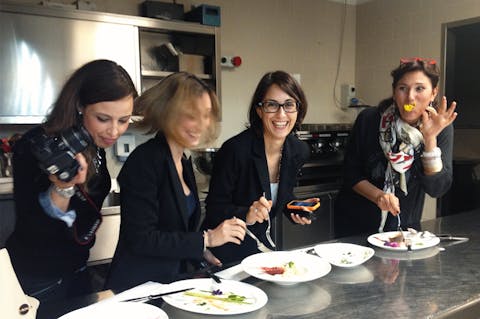
When Gionchetti enters the world of Da Vittorio in Brusaporto, she lives at two speeds. At dawn she sits behind a desk in a gym, working as a secretary to secure a steady income. Then she shuts down the computer, sheds one skin and plunges into events: weddings, corporate dinners, private banquets—nights in which every detail must function like a precision mechanism.
She refines the art of conceiving an event from start to finish, from the client’s first phone call to the moment the dining room is cleared. Listening to the request, matching it with technical and economic realities, building menus, rhythms, and service flows, holding together suppliers, kitchen, and front of house without anyone noticing—this is where she sharpens her sense of direction. These are years that teach her discipline, vision, and endurance, working on a project in which her emotional involvement is total. And it is precisely in this context, in close contact with the most codified forms of fine dining, that she becomes aware that service can turn into a standardized liturgy—a perfect but empty script—or remain a living act of relationship. She is allergic to the former.
“The problem is when service becomes protocol, when it feels like everyone is playing the same role, everywhere in the world,” she says. “It’s not hospitality to repeat the same phrases, in the same way, to completely different guests.”
Instead, she champions a vision of hospitality tailored to people. She is wary of formats that endlessly replicate the same language, the same smile, the same reassuring experience—yet remain detached from the reality of the territory and the work behind it. It is here that she begins to seriously question another theme close to her heart: the relationship between marketing and quality. And it is here that she feels a growing need to claim her own space, to express herself in broader, more international contexts.
The decision to leave Italy and shift the center of her life to Shanghai was not a sudden impulse, but the sum of many desires. On one side, the need to breathe in the world; on the other, meeting Stefano Bacchelli—chef and now collaborator and husband—along with a thought that became increasingly clear: to build a project that was truly their own.
First came the trips, site visits, and a few working seasons. China was already in the background before Covid: a possible horizon rather than an exotic dream. Then came the real decision—to move. Two weeks of hotel quarantine, shut inside a room, paradoxically became her first real rest after years.
“In quarantine, I slept,” she recalls. “I really slept. It was as if my body had been waiting for that moment to shut down and recharge.”
Her encounter with Shanghai had none of the dramatic overtones often associated with culture shock. “I approached China gently,” she says. “I no longer had the sense of urgency that defined me when I was younger. I lost my rush, finally. Psychotherapy helped me a lot. And Stefano, of course.”
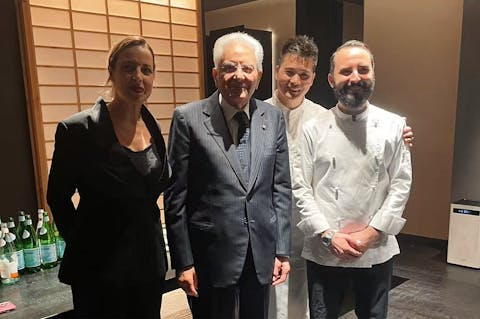
In her early years in China, she worked as an exclusive gastronomic consultant for a historic villa in the city, handling public relations, banqueting, events, menus, and international guests. It was a continuous laboratory in which she systematized everything she had learned up to that point—management, direction, relationships, vision—followed by many unforgettable memories, such as the private dinner for President Sergio Mattarella’s visit to Hangzhou.
The real turning point, however, was primarily personal rather than professional, and it did not arise solely from clear-headed career choices, but also from two “terrible periods,” as she calls them, that forced her to stop and truly face herself. “Psychotherapy changed my life and the way I look at it. Those sessions became a place of confrontation. You need someone who doesn’t know you and has no ties to you, who can tell you things as they really are.” One Post-it note stayed with her for years, written by her therapist: “Sometimes it’s nice to do nothing.” At first it was just a sentence stuck to the mirror; then the Italian lockdown arrived, and that phrase became a forced reality. Psychotherapy became the external point of view that helped her realign things whenever the pace of work threatened to overwhelm everything else.
In Gaia Gionchetti’s biography—shaped by Porto Cervo, Phi Beach, major international groups, and Shanghai—the issue of price is not a minor detail; it is a constant question. What is a gastronomic experience really worth? For her, the difference between expensive and overpriced is substantial.
A place can be expensive because there is real work behind it: trained professionals paid fairly, research, carefully selected ingredients, and time devoted to designing a menu, a service, and a dining room. This kind of expense tells a story of value, not just of a bill.
Overpriced is another matter: it is when the price is inflated by image, glossy storytelling, and an idea of luxury that does not translate into real quality—neither on the plate, nor in the service, nor in the overall experience. “Gastronomic marketing is extremely powerful and has always fascinated me,” she says. “But marketing rarely goes hand in hand with quality.” Her experience among celebrated restaurants, luxury destinations, guides, and rankings has left her with a very clear stance on the role of marketing.
“Lists and guides are useful tools, but they cannot be history books,” she says. She defends everyone’s right to develop their own taste, to choose the places where they feel good, to prefer a ramshackle trattoria over an impeccable three-Michelin-star restaurant if that is where they feel at home.
“Saying ‘to my taste, I prefer…’ opens up a space for dialogue,” she explains. “Saying ‘you can only eat well there’ shuts it down.”
A venue that communicates beautifully but treats suppliers poorly, underpays staff, uses mediocre ingredients, and hides behind a format is not a model for her. “The narrative has to rest on something real,” she says. “If the supply chain, the ingredients, or working conditions are not up to standard, no copy, no photo, and no reel can turn that into quality. They can only mask it—for a while.”
It is from this intersection—between personal taste, responsibility, labor, and truth—that her way of being a gastronomic consultant is born: someone who does not simply try to make an experience look beautiful, but strives to make it meaningful, sustainable, and fair, both for those who live it and for those who build it.
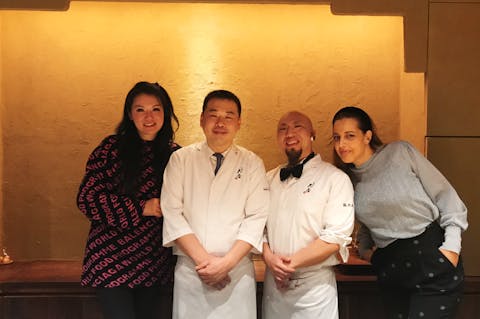
Today, Gionchetti lives and works in Shanghai, where her gastronomic consultancy has taken shape in three distinct yet interconnected entities: Scilla, Madre, and Cina Gastronomica.
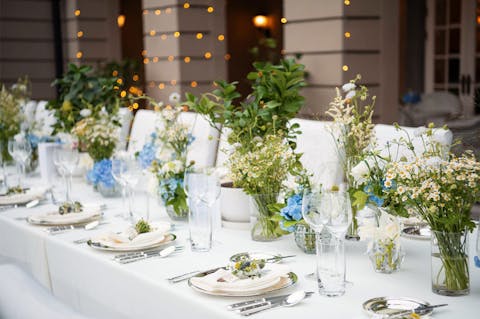
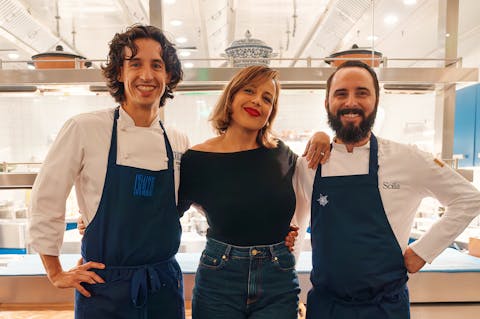
In 2023, her partner Stefano Bacchelli opened Scilla, a Mediterranean restaurant housed in a 1930s villa. The atmosphere is that of warm, welcoming casual dining, underpinned by an almost obsessive attention to detail: from the Mediterranean-blue pass and cooking blocks by Marrone, to the colored glassware echoing the hues of ceramics with light-blue speckles, to the wooden staircase whose color reappears in the rim of the Franco Fasano plates.
“As a gastronomic consultant, I supported the company in selecting several defining elements, such as the Apulian plates, the Pantone colors, and the graphic identity,” she explains. “When I see everything together, it still moves me.”
In 2024, alongside Scilla, Bacchelli opened Madre, an “Italian bar with an oven”—a statement of intent even before it became a name. It is a place that recreates the most everyday Italian gestures: coffee at the counter, a quick croissant, a fast lunch break, an afternoon snack with children—transplanted to the heart of Shanghai without losing its identity.
Around Scilla and Madre, Cina Gastronomica is now taking shape: the umbrella that brings everything else together. This is where consultancy projects for restaurants, chefs, and food-and-wine ventures converge, along with food trips for Italians in China and for Chinese guests in Italy, as well as cultural and gastronomic exchange projects between the Mediterranean and the Chinese world. The first chapter opened at the end of November with a week-long immersive program in Shanghai, featuring two four-hands dinners by chefs Stefano Bacchelli and Mattia Pecis of Cracco Portofino, presented to the local press with the support of the Italian Consulate in Shanghai during the Week of Italian Cuisine in the World.
Cina Gastronomica is the most mobile part of her work: the one that builds bridges, itineraries, and relationships. Hospitality is the word that brings it all together.
For her, hospitality is a constellation of gestures, often invisible: inviting someone into your home even if you barely know them; thinking through the guest’s journey from the very first contact; insisting that “bar italiano col forno” be written in full and strictly in Italian, because words are part of the experience and the identity of a place; spending hours threading ribbons and cardboard tags into panettone boxes so that those who receive them can sense they have been wrapped by hand, one by one.
From this perspective, hospitality is not a service subordinate to the chef, but an autonomous art: the ability to create a space in which others can exist fully, not merely as customers to be managed.
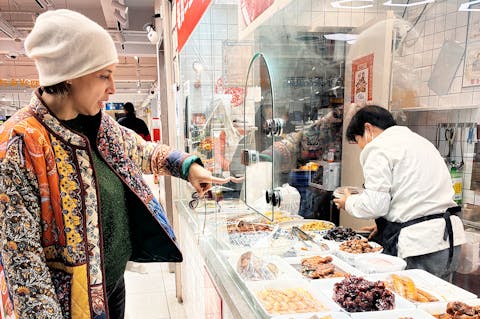
Talking about sustainability in Asia means accepting complexity. Distances are vast, logistics are relentless, fruit often arrives double-packaged, and many products travel thousands of kilometers.
“We would be dishonest to say that sustainability is easy in Asia,” she admits. “We use only high-quality ingredients—Italian where possible, and Chinese where it makes sense. We are the first to be genuinely happy when we find a good local ingredient, not just ‘good enough for me,’ but one with high yield, solid structure, and good performance in cooking.”
For bread and baked goods, they use carefully selected Italian flours. At the same time, they work with top-quality Chinese ingredients, such as fish maw, incorporating them into recipes that dialogue with Italian tradition—for example, in a risotto alla milanese.
This is a form of sustainability made up of compromises, choices, and constant adjustments, rather than slogans.
Then there is another level of sustainability, perhaps even more delicate: that of life itself. Gionchetti has chosen no longer to work exclusively for a single client. No more total availability without boundaries, no more professional identity tied to just one reality. “Work and private life overlap for me,” she says. “But precisely for that reason, I have to be careful. I can no longer work for just one person—I need to be able to choose projects and navigate among them, without risking burnout.”
Here, sustainability means having the right to say yes and no, to set boundaries, to stop sacrificing everything in the name of a single name on the door. It means being able to continue practicing one’s craft—hospitality—without ceasing to be a whole person.
Sardinia remains a fixed point, both emotional and tangible. Gaia Gionchetti returns there once or twice a year—far less than she would like. She misses the colors, the scents, and the people she cares about, with whom she would love to share even her successes.
When she goes back, there are mandatory stops that help put everything back into place: the Pevero kiosk run by Davide, where she gets up from her sunbed, eats, and lies back down; Mallica and breakfast at Elite in Cagliari, with those pizzette she says she could “eat by the hundreds.” They are small rituals, but they keep the thread alive.
“I would love to spend six months in Shanghai during the winter and six months in Porto Cervo in the summer—working, not on vacation. But the real dream is to have a place of our own in Gallura, bringing Italians to Shanghai and Chinese guests there, in a continuous cultural and gastronomic dialogue.”
Ultimately, all her work moves in that direction: building bridges between places, people, and cultures. Holding together Porto Cervo, Cagliari, Milan, Paris, and Shanghai within a single idea of hospitality—rigorous and passionate—in which food is never just a dish, but a way of being in the world.