The Cammino Minerario di Santa Barbara | Olianas
Itineraries
The Cammino Minerario di Santa Barbara
A journey through mines, landscapes, and communities in the heart of Sulcis-Iglesiente
In Sardinia, we preserve walking routes that cross landscapes, histories, and communities. Among them, one has become increasingly well known in recent years: the Santa Barbara Mining Trail. To truly understand it, however, it’s not enough to read a map or follow a track on a screen. You have to step into the places it comes from and listen to the people who imagined and built it. That’s why we reached out to the Foundation. Valentina, the communications officer, responded and arranged to meet us in Carbonia, one of the places from which many pilgrims choose to begin their journey. That’s where we arrive as well, on a morning when the sky timidly peeks through the clouds.
Valentina welcomes us together with Simona, coordinator of the project “The Carignano Trails” along the route. Both of them have the natural ease of those accustomed to telling the story of this land to those encountering it for the first time.
“Many people simply call it the Santa Barbara Trail”, they tell us as we begin to move, “but its full name is the Santa Barbara Mining Trail. And that word, mining, is not just a detail”.
They don’t insist, they don’t overload the moment with explanations: they simply guide us. Yet it is already enough to understand that, if we truly want to grasp the meaning of this journey, we must start here—from the places that gave birth to it.
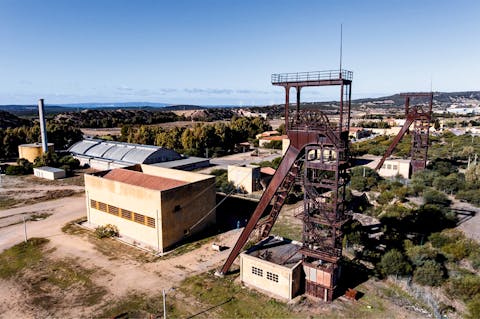
Our first stop is the Great Mine of Serbariu, now home to the Coal Museum. It is one of those places you enter with the immediate sense that what matters is not only what you see, but what still lingers in the air: the presence of a past that has not vanished, but has settled into the walls, the objects, the photographs, and the words of those who tell its story. At the entrance, after a large image of miners that keeps the past alive, we are welcomed by Mauro Villani, the museum’s director, who guides us through the rooms with the calm of someone who knows that certain places should not be overexplained, but gently accompanied.
As he speaks about Serbariu, Mauro is not just telling the story of a mine. He is telling the story of a world. Men who arrived from all over Sardinia and from many regions of Italy, families who moved here in search of hard but stable work, days marked by shifts that began before dawn and ended when the light had already changed, entire communities built around an activity that for decades represented the economic and social heart of the Sulcis-Iglesiente area. And yet, it is when the conversation turns to the Trail that everything truly comes into focus.
“You can’t talk about the Mining Trail if you haven’t first seen a mine”, he tells us. It’s a simple sentence, but a crucial one. Because the Santa Barbara Mining Trail was not created as a route designed for visitors, nor as a recent invention to make the area more appealing. It grew out of the paths miners walked every day. Trails that connected the tunnels to the villages, mule tracks taken at dawn to reach the work shift and again in the evening to return home. “Miners were already walking this Trail”, Mauro adds. “They just didn’t call it that”.
In that moment, the very name of the Trail takes on a deeper meaning. Mining, because it was born from work, from hardship, from the daily lives of those who crossed these places out of necessity. Santa Barbara, because in almost every mining site there was a sign of her presence: a chapel, a statue, a place of devotion, an image to entrust oneself to before descending underground. She is the patron saint of miners, and it is not hard to see why the Trail brings together these two dimensions: the concreteness of the earth and the human need to rely on something beyond it.
Walking among the photographs and the objects on display, those words become even clearer. Faces blackened with coal, hands marked by labor, gazes that speak not only of hardship but also of belonging. It is from those lives that the Trail is born—not as an abstract idea, but as a tangible trace left on the land. Today, those same paths are walked by pilgrims and hikers who come from all over Italy and other European countries. They cross the same landscapes, follow the same lines, but with a different perspective. And yet, something remains—like an invisible thread connecting those who lived these places every day and those who choose to walk them today.
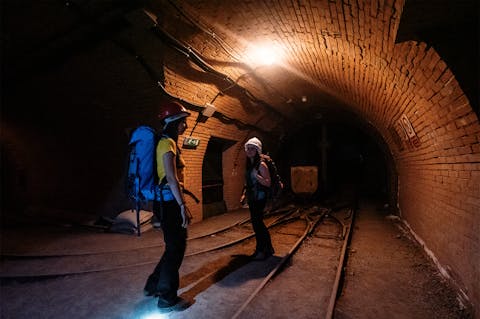
We leave the museum and soon meet the President of the Foundation, Mauro Usai, who helps us shift our perspective from a single place to the broader vision. We ask him where he would begin to describe this route to someone who has never heard of it. His answer doesn’t start with a map, nor with a list of stages. It begins with an image.
“I would picture a miner coming out of the mouth of the mine and, in front of him, finding the landscape of Sulcis-Iglesiente: the sea, the cliffs, a valley, a forest”. It is an image that already contains the core of the Trail: the meeting between a landscape of rare beauty and the history of those who lived these places in the most concrete way possible—working within them, crossing them every day, building a life there. “The Trail passes through extraordinary landscapes”, he tells us, “but it cannot be separated from the history of the people who lived them”.
It is precisely here that the Santa Barbara Mining Trail finds its fullest identity. It is not just a journey through nature, nor merely a cultural project aimed at preserving memory. It is the intertwining of both. Over time, he explains, the project has gradually taken shape, involving municipalities, local communities, associations, and regional stakeholders, until it became a network capable of connecting villages, paths, mining sites, places of hospitality, and shared visions. The core idea, however, has remained the same: to offer a different way of experiencing Sardinia.
“Many people come here looking for something different from what they imagine when they think of the island”, he explains. “Not just sea and beaches, but history, community, identity”. It is a statement that perfectly captures the essence of this route. The Santa Barbara Mining Trail belongs to a Sardinia that cannot be consumed quickly, that does not end with a season, that is best understood when experienced slowly.
For this reason, the quieter times of the year become the most vibrant. The Trail is mainly walked in spring and autumn, when the climate makes each stage more enjoyable and the land reveals rhythms different from those of the busy summer season. “We notice it when, during the quieter months, accommodations remain open”, he says. “When walkers arrive and communities come back to life during periods of the year that used to be much quieter”. In this sense, the Trail does not only change those who walk it: it also transforms the territories it crosses, redistributing presence, creating continuity, and keeping places open that would otherwise remain suspended.
There is another aspect he emphasizes with particular care: the younger generations. “Young people today often live immersed in devices, in the fast pace of cities, and in highly stressful work environments”, he says. “The Trail can become a space to rediscover a more human dimension”. It is not just a theoretical reflection: it is the idea that walking can be, especially for those living in constant acceleration, a concrete way to slow down, to listen, and to reconnect more authentically with places—and sometimes, with oneself.
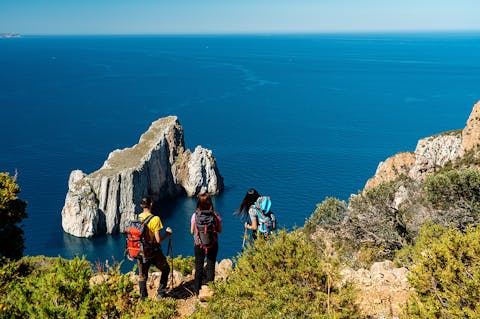
We say goodbye to the Foundation’s president and once again let Valentina and Simona guide us. “If we really want to understand where the Trail was born”, they tell us, “we have to go to Pozzo Sella”.
We leave Carbonia and head toward Iglesias. The road slowly changes its landscape and, without even noticing, the narrative changes too. If in Serbariu we encountered the daily life of miners, here we arrive at a place that speaks of ingenuity, transformation, and the future. Monteponi, in fact, is not only one of the most important sites in Sardinia’s mining history: it is also one of the places where the territory began to rethink itself.
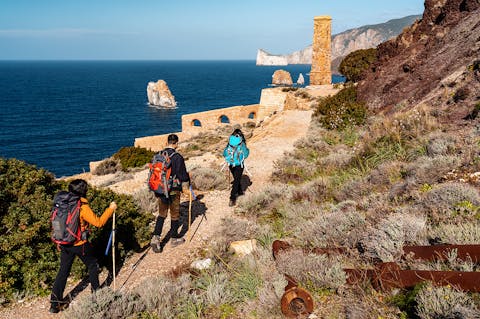
We are welcomed by Massimo Sanna, President of the Pozzo Sella Association. His story begins far back, when Monteponi was the heart of a vast metallurgical basin of lead, zinc, and silver, and Pozzo Sella represented one of the most ambitious attempts to solve a problem that seemed to halt everything: water flooding the underground and preventing further extraction. Here, in the 19th century, engineer Pellegrini designed an imposing system of boilers, steam, and large connecting rods that were meant to pump water out of the tunnels. It was a bold idea, modern for its time—but it didn’t work. And yet, even in that failure, something important remains: the measure of a territory that has always sought solutions when faced with obstacles.
But Pozzo Sella, in our journey, is not just the story of a technical challenge. It is above all a place that comes back to life much later, when the mining era comes to an end and these spaces are left with a question that no longer concerns the underground, but the destiny of the entire territory: what should be done with all of this?
“They couldn’t remain just ruins”, Massimo tells us. “They had to keep living”.
From this conviction comes a decisive turning point. First, the struggle to establish the Geomining Park of Sardinia—a struggle closely tied to the name of Giampiero Pinna, who went so far as to lock himself for a year inside the Villa Marina shaft to force institutions to respond to these territories. Then, in 2001, the founding of the Pozzo Sella Association, created by those who had supported that fight and did not want to stop at simply preserving memory. Because at a certain point it becomes clear that preserving is not enough: what is needed is to reconnect.
It is here that the idea of the Trail begins to take shape.
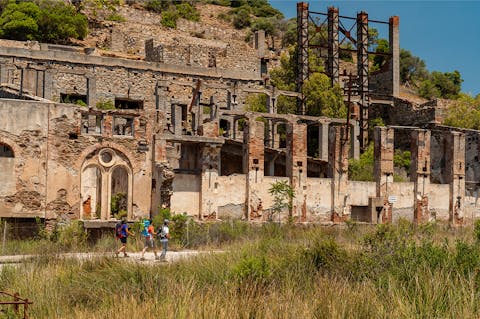
Massimo explains it very clearly: at the beginning, the goal was to retrace the paths that miners used every day to go to work—to rediscover those traces and restore their continuity. But from the outset, the project began to expand. Not only mining sites, but also villages, local productions, festivals, landscapes, biodiversity—everything that the territory is still able to express. This is how the Santa Barbara Mining Trail was born: not as an isolated path, but as a way to hold together places and everything that continues to live within them.
“It was a collective effort”, he recalls. And this is perhaps the most compelling part of his story. Because within that effort are the municipalities, each called upon to formally approve their participation in the project; there are university students, who studied and mapped the territory; and there are former miners, who knew those routes through direct experience. There is a genuine dialogue between generations and different kinds of expertise—between those who had lived in these places and those searching for a new way to give them a future.
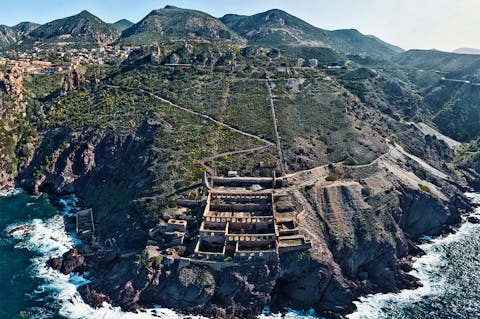
After passing through the places where the Trail was born, a different, more concrete question arises almost naturally: what actually happens when someone decides to set off? No longer just what this Trail is, but how you enter it, where you begin, what you encounter along the way. For this reason, we meet Andrea Tarozzi, Head of Marketing and Administration of the Santa Barbara Mining Trail Foundation. With him, the narrative shifts perspective once again: from memory to possibility, from origin to the real experience of those who choose to begin the journey.
Start by telling us something very simple — and, in a way, quite symbolic as well: “The first thing to do is to obtain the credential”. As with all great pilgrimage routes, this is the first step. The credential is the pilgrim’s document, the one that accompanies the journey and, stage by stage, fills with stamps, becoming a tangible record of the path taken. It is a small object, yet it contains everything: the beginning, the passage, the proof that the Trail has truly been walked.
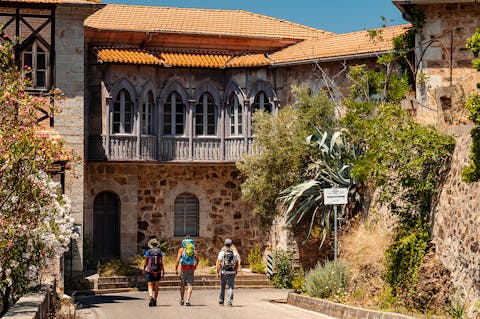
Today, however, the Santa Barbara Mining Trail has added something more. Alongside the paper credential—which remains important for its symbolic value—there is now a digital version: the Minera Card. Andrea describes it to us as a tool that makes the journey even more accessible and more connected to the territory. Through this platform, it is possible to register stages, have a personal page, activate benefits, and move along the Trail more easily. It is not just about technology, but about creating a system—bringing together the pilgrim’s experience and the network of places the Trail crosses.
With the Minera Card, in fact, it is possible to access agreements and discounts across many local realities: museums, mining sites, cultural landmarks, restaurants, experiences, and accommodations. This is an important aspect, because it clearly shows what this Trail is today: not just a path, but a web of relationships between those who set off and those who welcome them.
Today, there is no need to wait too long or to plan something overly complicated. You simply explore the route and choose where to begin.
The Santa Barbara Mining Trail, in fact, is a large loop and does not require a single starting point. Many choose Iglesias, but it is not a rule. You can join the Trail from different stages, depending on the time you have, the section you want to walk, and the kind of experience you are looking for.
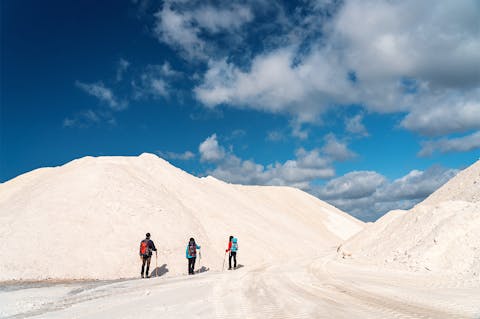
And this is perhaps one of its most interesting aspects: this Trail does not demand to be completed all at once. It does not impose itself as a challenge to be finished, but instead unfolds over time. “Many people don’t walk it in one go”, Andrea tells us. “The average is four or five nights. Then they often come back, maybe the following year, and continue". This changes the way you imagine it. It removes any sense of rigidity and restores the Trail to its most human dimension: that of an experience that can adapt to each person’s time. Some set off for just a few days, others choose a specific section, others return multiple times. In this sense, the Trail does not ask for performance—it asks for openness.
Along the route, there are also the Posadas, which Andrea describes as one of the most tangible and meaningful elements of hospitality. Some have been created by restoring public buildings; others are located in places that have been brought back to life specifically to host pilgrims. They are simple spaces, designed for those who walk: you sleep, you wash, you eat something, and then you set off again. But above all, you encounter a different rhythm. Alongside the Posadas, there are also affiliated private accommodations—bed and breakfasts, agriturismi, guesthouses, hotels. This means the Trail can be experienced in different ways, more essential or more comfortable, without losing its spirit.
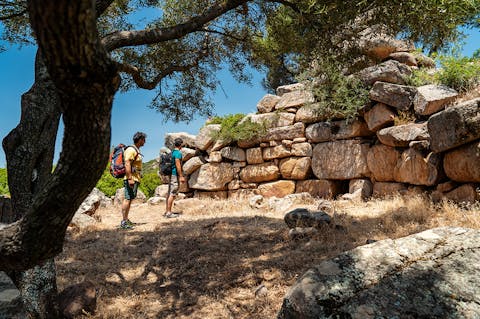
And then there is everything that cannot be fully planned, yet often becomes what stays with you the most. When Andrea speaks about the testimonies received from pilgrims, his tone shifts slightly. You can sense that there is something there that goes beyond management, beyond organization. “Many people write to us after they finish”, he says. “And they tell us they didn’t expect such an intense experience”.
The word that comes up most often is not fatigue. Nor is it even beauty, although there is a great deal of beauty along the Trail. The word that returns again and again is hospitality. Those who walk the Santa Barbara Mining Trail speak of the villages, the people they meet, the feeling of having been expected—or at least recognized. They describe a land that does not simply allow itself to be crossed, but somehow takes part in the journey.
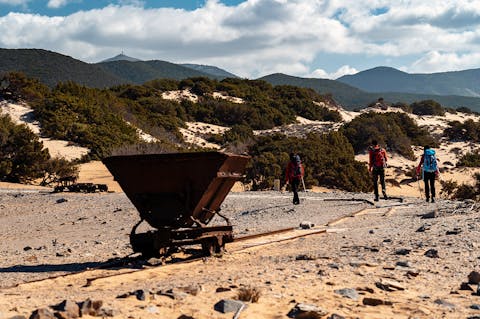
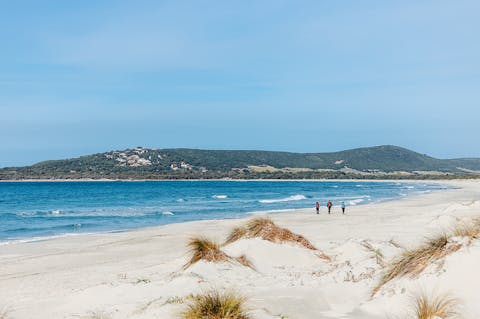
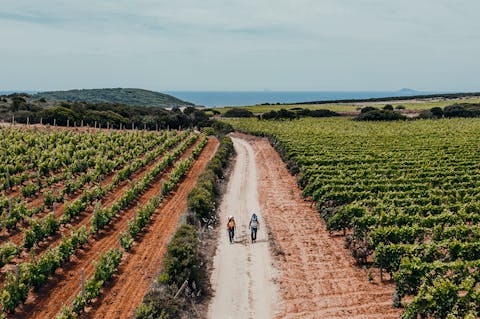
And it is here that the Trail definitively stops feeling like just an itinerary. Because yes, there are the landscapes: the forests, the mines, the coastal stretches, the inland villages, the ups and downs of the terrain, the sea that sometimes appears suddenly. But what truly remains, more often than not, is the way all of this is experienced: slowly, with time to pause, with time to understand, with time to be surprised.
Perhaps this is also why the Santa Barbara Mining Trail speaks to such a wide range of people. To those seeking a physical experience, to those in search of a pause, to those who want to discover a lesser-known side of Sardinia, to those who need to put their thoughts back in order, and to those who simply feel that the time has come to set off.
And so, at this point, the initial question changes.
It is no longer just: “What is the Santa Barbara Mining Trail?” It becomes instead:
“When do I leave?”