Su Sessineddu, the ritual of Gergei that weaves together faith, childhood, and community | Olianas
Vite
Su Sessineddu, the ritual of Gergei that weaves together faith, childhood, and community
In Gergei there are days you can feel before they even arrive.They announce themselves with a subtle vibration that slips into homes and then spreads through the streets.As February 3rd approaches, winter continues to do its work, but the village does another: it prepares.
It’s not just a date on the calendar.It’s Saint Blaise, and you recognize it in the sense of waiting that settles in kitchens, in the increase of visits, in hands that return to motion to give shape to a rite that, every year, sets relationships back in order.
That rite has a name: Su Sessineddu.
It is a shared gesture, a handed-down grammar, something done together and, for that very reason, never belonging to just one person.
Our journey begins like this: entering the village the way one enters certain stories, by following the people.
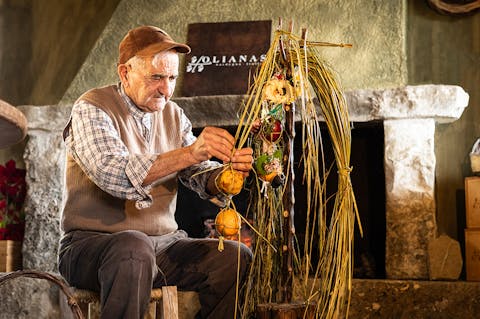
The first stop is at Vinicio’s place, where he waits for us in front of the fireplace.The fire is lit, but the true center of the scene is his hands.As he speaks, they work.As they work, they tell a story.
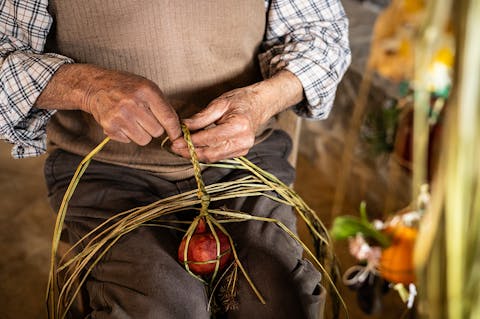
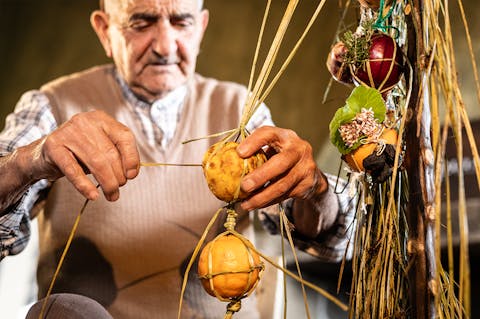
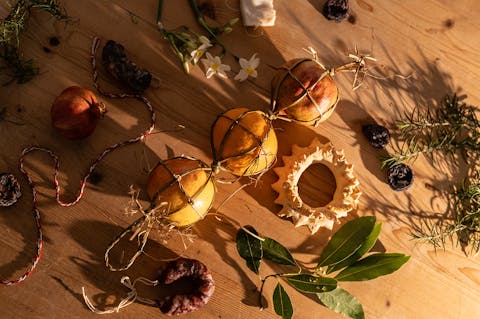
On the table are the sessini: long, resilient leaves, soaked in the days before to make them pliable and prevent them from breaking.Vinicio selects six of them, bends them with a confident gesture, and begins the weaving, unhurried, as he tells us, “I learned from my grandmother; I was six, maybe seven years old.”From there, everything takes shape.First the structure, then the rest.Vinicio adds the fruits one by one: oranges, pomegranates, whatever the season offers.Each element finds its balance.Su Sessineddu grows in his hands, becoming recognizable.It is not created to be looked at for its simple beauty, but to be carried: first in procession, then to the church for the blessing, and finally back home.
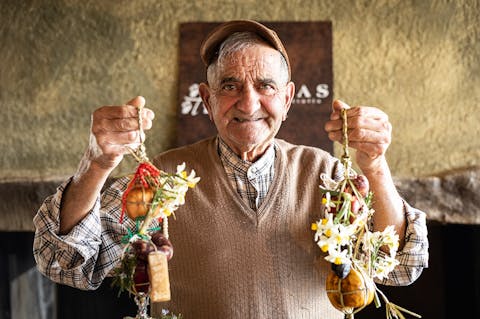
We say goodbye to Vinicio and reach Valeria.With her, Su Sessineddu changes space.It enters the childhood home, the most intimate memories, and she tells us about it with the natural ease of someone who never really had to explain it to herself: “As children, we waited for this time with the good kind of anxiety that comes with big celebrations.Su Sessineddu for us represented the feast of Saint Blaise, but also the children’s feast.”Before the religious celebration, however, there is the home.The table.Those who know how to do it and those who watch.Valeria remembers her father preparing Su Sessineddu for all his children, one by one, without making distinctions.Or almost.“There were five of us.I was the youngest, so mine was always a little smaller.”She says it smiling, also recalling that small childhood injustice: fewer Rossana candies, less space.But within that scene there is something that goes beyond the detail.There is a tradition that enters life without asking for solemnity, that accepts being imperfect.Then comes the procession.And in the procession, there is a role.Children in line, the object in their hands.“When you’re a child and you carry Su Sessineddu in the procession, it feels like a small trophy.You’re proud to carry it.”It is a responsibility that is tiny and immense at the same time: holding something in front of you, crossing the village, and arriving at the church for the blessing with a deep sense of belonging.It is a memory made of warm voices and streets walked together.
Following our path, we arrive at the Pro Loco of Gergei, together with Gabriella and Rita, who are part of the board.Here, in these days, tradition is very much a work in progress.
Gabriella explains how Su Sessineddu is linked to Saint Blaise, but also to a more distant, almost mysterious story.A depiction found in Thebes, in Egypt: a young man wearing a pendant of fruits.The hypothesis is that monks brought this gesture as far as Gergei—not as a certainty, but as a trace.“We don’t know everything,” she says.“But we know that here it became ours.”Alongside Su Sessineddu there are other signs that return every year.The bread.The crowns.The little cord.“Su cordonittu. It’s a braid of colored threads.Once blessed, it was worn around the neck to protect against sore throats.Saint Blaise is the protector of the throat.”Gabriella recalls when they were children, how their mothers made them wear it all winter.They washed it with the rest of the laundry and then put it back on them.A small, everyday gesture that held faith and care together.
Over the years, Su Sessineddu has changed as well.Gabriella says this without nostalgia and without defensiveness.“The ancient one was taken up again by the Pro Loco in the 1980s.Then the modern version arrived, with candies and chocolates.Children prefer it that way.And it’s right that it is so.”Here, tradition is not crystallized, but accompanied: to remain alive, it must also be able to speak to the youngest.
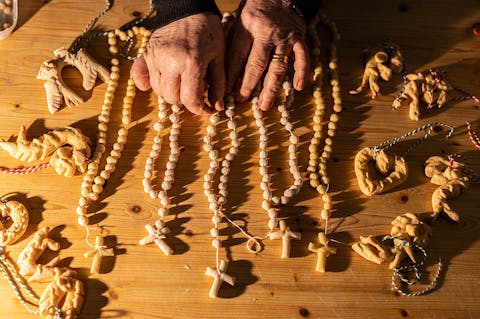
Among the recurring symbols that cannot be missing are the bread and the crowns.In the room next to us, a workshop is taking place.Grandmothers sit side by side along the tables, and in front of them are the children.They work the dough that will become the bread rosary to be placed on Su Sessineddu.The more experienced hands guide the little ones, gesture by gesture, with patience.The children try, make mistakes, try again.The grandparents adjust, show again, and smile when the movement finally “works.”In that room, one simple truth becomes clear: a tradition is not preserved by celebrating it once a year, but because someone, beforehand, takes the time to teach it.And someone, on the other side of the table, accepts to learn.
Mentre tutto questo avviene, Rita prosegue il racconto: “La Pro Loco aiuta il comitato a fare in modo che la festa continui. Prima c’era un solo obriere: ogni anno una sola famiglia si occupava di tutta l’organizzazione e si faceva carico di tutte le spese. Con il tempo era diventato troppo oneroso. Così si è deciso di condividere organizzazione e spese”. Oggi sono i bambini di dieci anni, quelli che hanno fatto la prima comunione l’anno prima, a essere gli obreri della festa. Le famiglie partecipano, si organizzano, si dividono i compiti. La Pro Loco affianca, sostiene, tiene insieme i pezzi. “Noi ci occupiamo della cena della sera del 2,” racconta Rita. “È una cena semplice: ceci, salsiccia arrosto, formaggio, vino. La offriamo a tutti quelli che vengono. È un momento importante, perché lì si ritrova il paese”. Non è solo una questione pratica. È una scelta precisa: fare in modo che nessuno resti fuori. La sera del falò non è un evento collaterale, ma parte del rito. Si mangia insieme, si resta insieme, si entra tutti nello stesso tempo. Rita ci racconta anche del pane, quello che verrà benedetto il giorno dopo e distribuito alla fine della messa: “Il pane lo offrono il comitato e i genitori dei bambini. Ne prepariamo tanti, perché arriva tantissima gente da fuori. È un segno semplice, ma per noi è fondamentale.
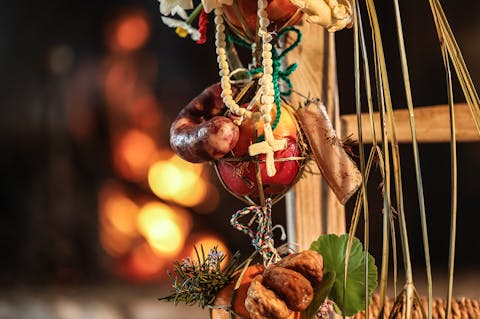
When February 3rd ends and the streets fall silent, Su Sessineddu does not disappear.It returns to homes, to memories, to the stories that will continue to be passed from mouth to mouth.It does not remain hanging as a distant symbol: it is eaten, shared, consumed.As happens with living things.In Gergei, tradition is not preserved by putting it aside.It is renewed each year because someone weaves, someone teaches, someone learns.Because there is always a hand ready to guide another.Maybe this is the deepest meaning of Su Sessineddu: not what is seen on the day of the feast, but everything that happens before.The time spent together.The care.The responsibility of keeping a thread stretched across generations.And it is there that this rite continues to do its best work: holding a community together, year after year.