
Essentzia and L’Atypica: Two New Ways to Tell the Story of Coffee in Cagliari | Olianas
People
Essentzia and L’Atypica: Two New Ways to Tell the Story of Coffee in Cagliari
There is a uniquely Italian paradox when it comes to coffee: we regard it as a sacred ritual, a source of national pride, yet we know very little about the raw ingredient that fills our cups every morning. We treat it as a pick-me-up, we say “I like coffee,” but we forget that before it becomes a beverage it is a fruit — an agricultural product with a season, a place of origin, and a producer. And that there are many different varieties, just like the grapes from which we make wine.
In Cagliari, at the end of 2025, two roasteries opened with a mission that is, in some respects, aligned: to build a culture around coffee. I’m referring to Essentzia, a project by Gianluca Mereu, and L’Atypica, founded by Ludovica Ladu and Carol Mello. Thanks in part to their vision, the paradigm of the quick espresso at the counter is shifting in Cagliari, with the aim of restoring coffee to the heart of a conscious culture — one that moves away from the rush of the bar and closer to the relationship between people, places, and choices.
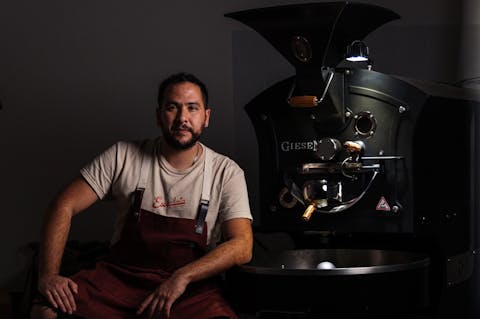
For Gianluca Mereu, coffee has been a long journey shaped by study, movement, work, and constant curiosity. Originally from Assemini, just a few kilometers from Cagliari, his travels first took him to Spain, then to Ireland,Australia, and Vietnam. Each experience was bound by a common thread: understanding that coffee is never the same.
“The more I studied, the more I realized I didn’t know enough,” he says. A sentence that reveals much about his vision: coffee as an ongoing learning process, never a definitive truth.
Working in international settings — managing large teams and training people from different countries — showed him how many coffee cultures exist beyond the Italian model. It is a product that changes according to habits, brewing methods, consumer sensibilities, and, above all, one that can be told as a story.
The turning point came during a trip to Vietnam, when he met a producer who, during a tasting, repeated a phrase to him: “smell the essence”. Feel the essence. That experience became almost symbolic, eventually giving its name to the project that would come later, when he decided to leave his career abroad and return to his hometown to open a roastery.
Essentzia was born with the idea of making quality coffee accessible and understandable — a space for learning. In his approach, sustainability is not a slogan: it means direct relationships with producers whenever possible, knowing the cooperatives, understanding where the economic value of the product truly goes. “If the price is too low,” he explains, “someone along the supply chain is paying the price — and usually it’s the producer.”
The goal is twofold: to educate consumers and to shift the perception of price, because behind a single cup lie months of work — harvesting, shipping, roasting. “When you know all this,” he says, “those few extra cents don’t seem so unreasonable.”
But another form of sustainability also emerges in his story: that of time. Coffee as a real pause, not a compulsive gesture — a moment that creates community. “It often happens that someone buys coffee for their father, their mother, for someone they love. That’s when you realize something has changed.”
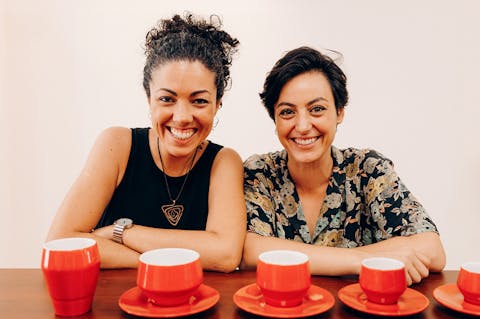
If Essentzia’s story begins with a professional journey, L’Atypica’s is born from a personal encounter. Carol Mello, a musician, comes from São Paulo, Brazil, after spending many years in Portugal; then a trip to Sardinia for a concert sparked her love for this land — and for Ludovica Ladu, her partner in both life and business. Ludovica followed the opposite path: born and raised in Sardinia, she lived in Brazil, where she began to see coffee differently from how she had always experienced it in Italy. “When you live in a producing country, you can no longer pretend it’s just a beverage: it becomes territory, agriculture, human labor, community,” they tell me.
In Brazil, coffee is home. Carol recalls that in her family they always drank filter coffee — an everyday domestic ritual. It is the grandmother’s gesture of preparing coffee the way our grandmothers prepare tomato sauce: slowly, as an act of care that holds the day together. “Home coffee is filter coffee”, she says — and in that sentence there is an entire geography: a way of living the product as sharing, as a familiar language.
For this reason, when Carol meets Ludovica, it is not merely a shared passion added to their relationship: it is a common vocabulary expanding. Ludovica describes her “first click” as a revelation — realizing that coffee is an agricultural product. A meaningful awareness in a country like Italy, where coffee is often experienced as an automatic gesture: you walk in, order, drink it down. In Brazil, more often, it takes the shape of shared time.
From this shared passion comes the idea of creating their own space, where coffee becomes the center of a wider network of cultural relationships, music, and encounters — a place where what truly matters is everything that a cup can set in motion.
Within this project, Carol brings the concept of discovering diversity. “There is no such thing as ‘the taste of coffee,’” she says. “There are many tastes, many possibilities.” Coffee tells something about the person who drinks it and the one who prepares it. That is why L’Atypica’s choice is radical: working exclusively with single origins, no blends. Each coffee is tied to a specific territory, a producer, a precise story — and the sensory narrative becomes a way to bring back into flavor that agricultural dimension often lost in Italy. “For us, giving value to coffee means starting from geography,” Ludovica explains. “Connecting what you taste in the cup to the journey that product has taken.”
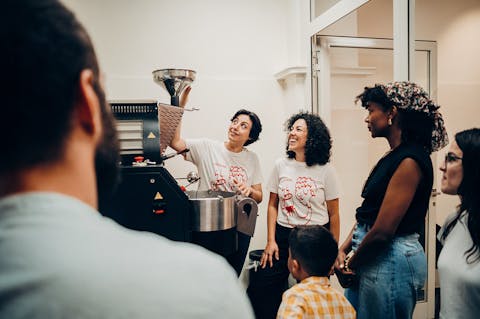
Essentzia and L’Atypica start from different perspectives — on one side, a roastery with a strong technical and educational focus; on the other, a cultural and relational space — yet they converge toward a shared idea: coffee as culture.
Both realities place people at the center. First and foremost, the producers, who are often invisible. But also consumers, who are invited to become more curious, more aware. There is no need to be experts — only the willingness to understand.
One element repeatedly emerges in the stories of all three founders: curiosity. An audience that is changing, increasingly willing to ask questions, to discover the differences between Brazil, Colombia, Ethiopia, or Costa Rica, to understand why one coffee is sweeter or fruitier than another.
Coffee thus becomes a bridge between territories and cultures, but also between generations. Gianluca, Ludovica, and Carol all speak of twenty-year-old customers interested in new brewing methods, already remarkably aware, as well as people over sixty who, for the first time, discover the product they have always loved — and allow themselves to be guided.
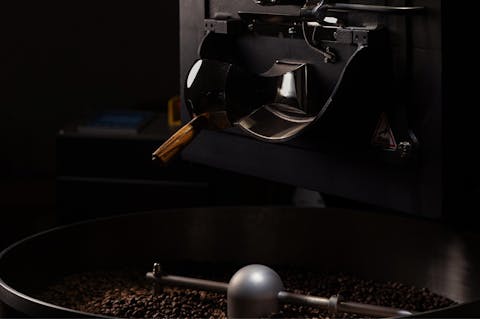
At a historical moment when the word sustainability risks becoming an emptied-out formula, the work of Essentzia and L’Atypica brings the conversation back to the concrete level of shared responsibility along the entire supply chain — an awareness of what exists before and after the cup.
For Gianluca Mereu, the foundation of his work lies in the need to reduce the distance between those who produce and those who consume, by telling the story of the months of cultivation, the selective harvesting of ripe cherries, the different processing methods, the shipments, and the calibrated roasting designed to make visible what usually remains hidden.
Sustainability, in this vision, is also educational. Mereu strongly emphasizes the idea of making quality coffee accessible rather than elitist, while at the same time educating people about why more attentive agricultural practices exist, why a fairer supply chain matters, and why roasting should be designed to enhance the origin rather than standardize it. It also means restoring dignity to time: drinking a coffee as a small, conscious pause — aware of what we are truly drinking.
Alongside this economic and educational dimension, Essentzia proposes what could be defined as relational sustainability: the fact that customers buy coffee for their families, that they want someone else to taste it, suggests that sustainability concerns not only the land, but also social habits and the way coffee builds connections.
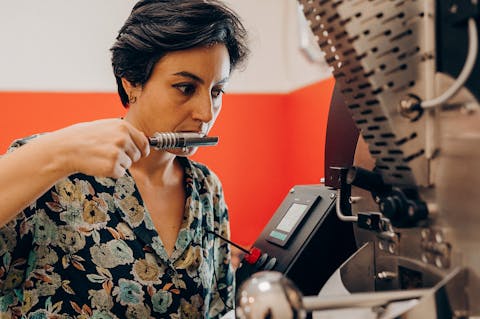
L’Atypica moves on a complementary plane, where sustainability becomes above all a cultural and narrative matter. Ladu and Mello begin from the assumption that one cannot speak of sustainability without first recognizing coffee as an agricultural product. Eliminating blends — while acknowledging their technical value — becomes, for them, a way of making the supply chain legible: each coffee has a name, a place, a producer, a precise story. Sustainability, then, serves to give identity and dignity to what often arrives anonymously in our cups, restoring complexity and diversity to a product the market tends to standardize.
For Mello, who grew up with filter coffee prepared at home by her grandmother, sustainability also means sharing. In Brazil, coffee is both a domestic and collective element, and L’Atypica seeks to bring that dimension into the space it is building: a place where coffee is not drunk in haste, but lived. Offering “coffee without hurry” — a sign clearly visible at the counter — is, ultimately, an act of social sustainability: restoring space to the relationship between the one who prepares and the one who drinks.
Both realities, though with different approaches, challenge the dominant idea of coffee as fast and standardized consumption. Drinking good coffee is not merely a matter of taste, but a choice that concerns the body, because what we consume every day has a real impact on us.
It is here that these two stories meet, transforming an automatic gesture into a conscious act — one capable of placing at the center once again the value of people, places, and the time required to do things well.
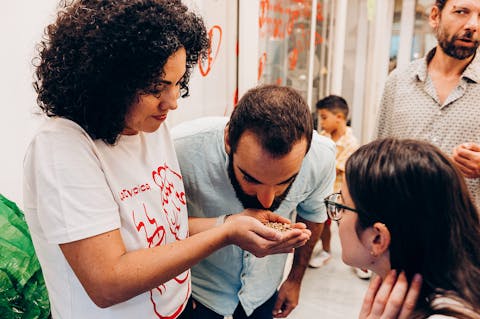
From conversations with both realities and from the way they are evolving, a shared vision emerges: a more human coffee, a moment of connection and conscious choice. I believe this transformation is also linked to the moment Cagliari itself is experiencing.
In recent years, the city has changed pace. Those who travel more, those who return after experiences abroad, those who bring back new habits and new questions have begun to reshape the way people look at food and drink. Both Essentzia and L’Atypica observe this through their customers: people who are more curious, more discerning, interested in understanding what they are drinking, capable of distinguishing one origin from another, and willing to listen to the story behind a cup. This shift does not concern only a niche of enthusiasts: it is visible in younger generations approaching alternative brewing methods, but also in those who had never before considered coffee as something to be chosen.
The decision to open a space dedicated to coffee does not arise in a cultural vacuum, but within a community that is beginning to seek out different kinds of places — places capable of offering time and narrative, not just product.
In this sense, the city becomes fertile ground: small enough to allow relationships to flourish, dynamic enough to welcome new visions. Essentzia works on education and accessibility, striving to make quality coffee part of everyday life; L’Atypica builds a space where coffee becomes a pretext for creating cultural and social connections. Two different approaches, both rooted in a shared idea: coffee as a space of encounter.
The future these realities suggest is made of small shifts in perspective. Perhaps the most interesting sign is the growing interest in a deeper need for quality and awareness. And so coffee ceases to be merely a habit and returns to what, in its most authentic origins, it has always been: a social ritual.
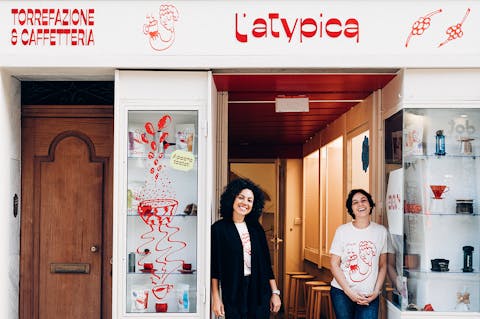
The images on this page are published courtesy of Roberto Satta and Emanuela Meloni.